

For Long Island families, the best hardwood floor solutions combine dust-free professional sanding with either a UV-cured finish for same-day furniture return or a low-VOC water-based finish for households with chemical sensitivities. Both approaches minimize downtime, protect indoor air quality, and deliver the durability busy homes demand.
Choose based on your household’s schedule and needs:
- UV-cured finish: Best when you need floors back in use the same day. Professional UV equipment triggers instant crosslinking, creating a hard, scratch-resistant surface without the 24–72 hour wait of conventional coatings. Ideal for families with young kids, pets, or tight schedules.
- Low-VOC water-based finish: Best for households with asthma, allergies, or strong odor sensitivities. Cures in 24–48 hours with minimal fumes, and families can typically return to treated rooms within a day.
Saverawoodfloorrefinishing serves Huntington, NY and surrounding Long Island communities with both options, using dust-free sanding and UV-cure workflows designed specifically for family homes.
Key Takeaways
For Long Island families, dust-free professional sanding paired with a UV-cured or low-VOC water-based finish is the most reliable path to durable, safe hardwood floors with minimal household disruption.
| Point | Details |
|---|---|
| Best finish for fast return | UV-cured finishes cure the same day via professional UV lamp, ideal for busy family schedules. |
| Best finish for sensitivities | Low-VOC water-based finishes cure in 24–48 hours with minimal odor, suited for asthma or allergy households. |
| Recoat vs. refinish rule | Use the water-bead test; recoat if finish is intact, refinish if raw wood is exposed or stains have penetrated. |
| Maintenance cadence | Schedule a professional screen and recoat every 2–5 years to extend finish life and delay full refinishing. |
| Local Long Island provider | Saverawoodfloorrefinishing serves Huntington, NY and surrounding areas with dustless sanding, UV-cure, and low-VOC finishes. |
Table of Contents
- Which finish is right for your family home?
- Should you recoat or fully refinish your floors?
- What to expect from the Saverawoodfloorrefinishing process
- How dust control and low-VOC finishes protect your family
- Keeping your floors looking great under family use
- Costs, planning, and questions to ask before hiring
- Why professional execution makes the difference for Long Island families
- A note from Savera Wood Floor Refinishing
- Ready to get your Long Island floors refinished?
- Sources
- FAQ
Which finish is right for your family home?
Choosing between UV-cured, low-VOC water-based, and traditional oil-based finishes comes down to three things: how fast you need your floors back, how sensitive your household is to fumes, and how much long-term durability you need.
| Feature | UV-Cured | Low-VOC Water-Based | Oil-Based |
|---|---|---|---|
| Durability / hardness | Excellent (instant crosslinking) | Good | Good to excellent |
| Curing time / downtime | Same day (hours) | 24–48 hours | 3–7 days |
| VOC levels and odor | Very low | Low | High |
| Scratch & chemical resistance | Superior | Moderate to good | Good |
| DIY vs. professional | Professional only | Professional recommended | Professional recommended |
UV-cured finishes deliver superior hardness because the professional UV lamp triggers an instant crosslinking reaction, producing a more uniform and durable coating than conventional drying methods. One important note: the film is slightly soft immediately after application and only reaches full hardness after UV lamp exposure. That means the professional equipment, not just the product, is what creates the durable surface. No rental machine replicates this.
Oil-based finishes are the most familiar but the hardest on families. Fumes linger for days, and you are essentially tiptoeing around for up to 72 hours or more before normal use resumes. For a home with kids and pets, that is a real disruption.
Pro Tip: UV-cure delivers the most value on projects of 500 square feet or more where the professional can set up the lamp system efficiently. Smaller rooms or tight timelines still benefit, but the cost-per-square-foot advantage is clearest on larger main floors.
For families with young children or asthma, low-VOC water-based finishes are the practical middle ground: low odor, reasonable cure time, and good durability. For households that simply cannot afford multi-day disruption, UV-cured is the clear answer.
Should you recoat or fully refinish your floors?
The decision between a screen and recoat and a full sand-and-refinish is simpler than most homeowners think. Start with a quick water-bead test: drop a few tablespoons of water on the floor. If it beads up, the finish is intact and a recoat may be all you need. If it soaks in within a few minutes, the finish has worn through.
Choose a screen and recoat when:
- The finish is dull or lightly scratched but structurally intact
- No raw wood is visible
- There are no deep gouges, pet urine stains, or warping
- You want a cost-effective refresh without full downtime
Choose full refinishing when:
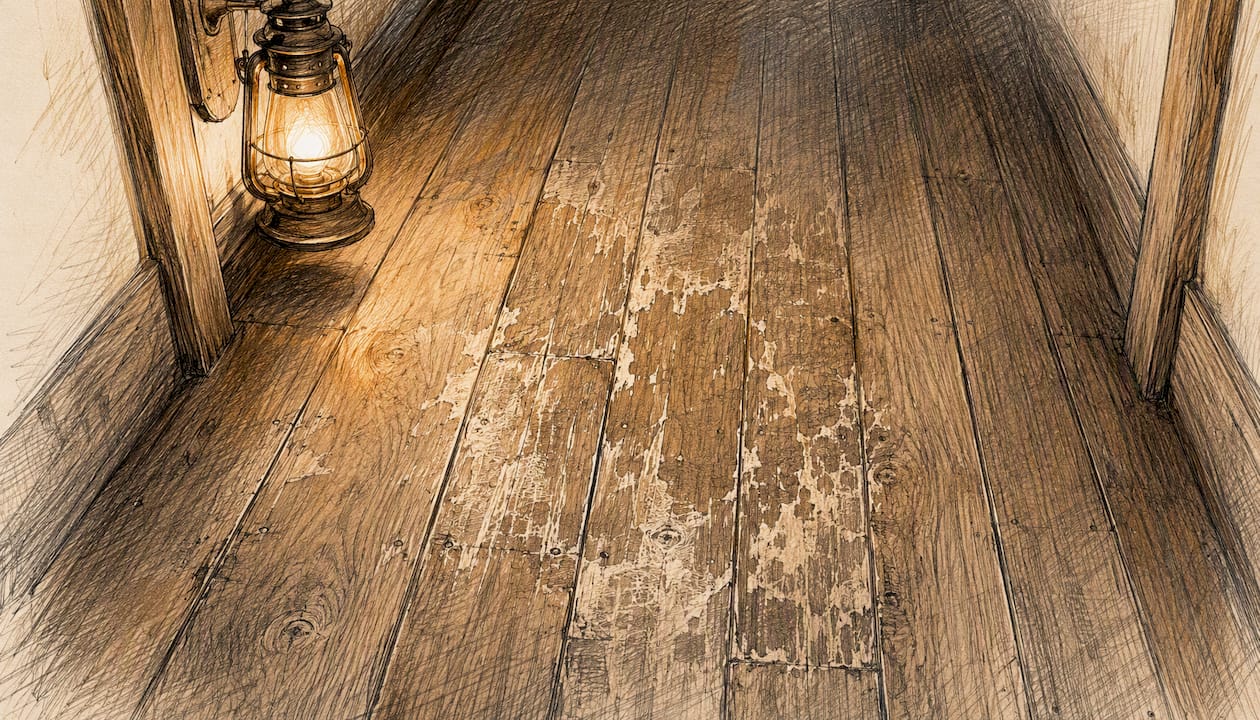
- Raw wood is exposed in high-traffic areas
- Deep scratches or dents reach the wood itself
- Pet urine stains have penetrated the finish
- You want a color or stain change
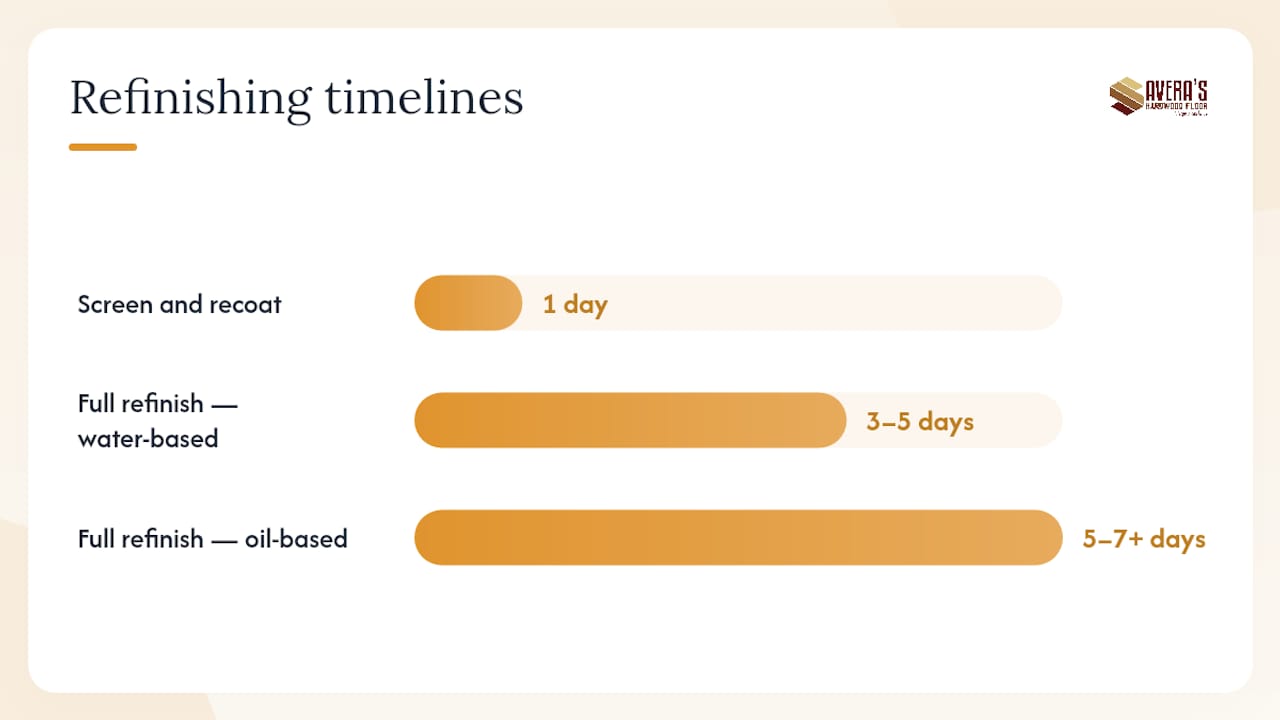
A screen and recoat uses a 120–150 grit sanding screen to scuff the existing finish and bond a new topcoat without sanding to bare wood. It is a one-day process for most homes. Full refinishing, by contrast, typically takes 3–5 days for water-based finishes and longer for oil-based finishes, including drying time between coats.
Timeline at a glance: Screen and recoat: 1 day, return same evening or next morning. Full refinish with water-based finish: 3–5 days. Full refinish with oil-based: 5–7 days or more.
Regular maintenance recoats every 2–5 years can push full refinishing years into the future, saving you significant cost and disruption. For a busy Long Island household, that cadence is worth planning around. You can also check signs your floors may need refinishing to catch wear before it becomes a full-sand situation.
What to expect from the Saverawoodfloorrefinishing process
A professional job from Saverawoodfloorrefinishing follows a clear sequence, and knowing it helps you plan around school schedules, pet arrangements, and furniture logistics.
- Inspection and scope confirmation. The crew assesses floor condition, identifies damaged boards, and confirms whether recoating or full refinishing is the right call.
- Furniture removal and surface prep. You clear the room; the crew handles floor-level prep and protects adjacent areas with sectional plastic containment.
- Dustless sanding. Industrial cyclone separators and HEPA-filtered vacuums capture approximately 99% of sanding dust at the source, keeping microscopic particles out of your living spaces. This also prevents micro-nibs in the finish that cause premature wear.
- Screening and edge work. Edges and corners receive hand or detail sanding with proper HEPA capture to match the field.
- Finish application. The chosen finish is applied in coats, with light screening between coats for adhesion.
- UV cure or drying interval. For UV-cured finishes, the professional UV lamp is passed over the surface, triggering instant hardening. Water-based finishes cure in 24–48 hours; oil-based finishes require 3–7 days.
Dustless sanding with modern industrial extraction also means many families can remain in their homes during the project. A typical 1,000 square foot main floor takes roughly 2–3 days with a dustless workflow, compared to the extended cleanup and air-clearing that traditional sanding requires.
How dust control and low-VOC finishes protect your family
Indoor air quality is the concern most families underestimate until the project is underway. Here is what actually matters:
- VOC differences: Oil-based finishes release high levels of volatile organic compounds during curing. Low-VOC water-based finishes cut that exposure sharply, with minimal odor and faster off-gassing. UV-cured finishes have very low VOC profiles because the curing reaction is photochemical, not solvent-evaporation-based.
- Airborne wood dust: Even fine sanding dust carries particles small enough to irritate airways and settle into HVAC systems. HEPA filtration in a professional dustless system captures particles down to 0.3 microns, the size range most relevant to respiratory health.
- Sensitive occupants: Infants, toddlers, and pets spend more time at floor level and are more exposed to both dust and off-gassing fumes. Dustless sanding and low-VOC or UV-cured finishes reduce both risks.
Pro Tip: Keep infants, toddlers, and pets out of the work area and adjacent rooms during sanding and for the first few hours after finish application. Open windows on the opposite side of the house to cross-ventilate. For UV-cured finishes, re-entry is typically safe the same day once the crew confirms cure completion.
Keeping your floors looking great under family use
Daily habits extend finish life more than any single product. A few consistent practices make a real difference.
Daily and weekly habits:
- Place entry mats at every exterior door to trap grit before it reaches the floor
- Add felt pads under all furniture legs and replace them every 6–12 months
- Trim pet nails regularly to reduce scratch depth
- Wipe spills immediately with a dry or barely damp cloth
Periodic maintenance schedule:
- 6 months: Inspect high-traffic areas for early finish wear; clean with a pH-neutral hardwood cleaner.
- 1 year: Check for dull patches or micro-scratches; consider a professional screen and recoat for Long Island homes if wear is visible in main corridors.
- 3 years: Assess whether a full recoat is warranted based on traffic patterns and finish condition.
- Every 2–5 years: Schedule a professional screen and recoat to maintain the protective layer and postpone full refinishing.
Costs, planning, and questions to ask before hiring
Ballpark costs for Long Island hardwood floor refinishing vary based on several factors:
- Square footage: Larger projects lower the per-square-foot cost.
- Sanding vs. screening: Full sanding costs more than a screen and recoat.
- Stain or color change: Adding a stain change adds labor and material cost.
- Board replacement: Damaged boards needing replacement add to the total.
- Finish type: UV-cured finishes carry a premium over standard water-based options.
- Long Island market: Labor and material costs on Long Island run higher than national averages.
Questions to ask any contractor before hiring:
- Do you use dustless sanding equipment with HEPA filtration?
- What is your dust capture rate, and how do you handle edges?
- Do you carry liability insurance and workers’ compensation?
- Can you provide references from family homes with similar scope?
- What warranty or guarantee do you offer on the finish?
- Do you have UV-cure equipment on-site, or do you subcontract that step?
Pro Tip: A contractor who cannot answer the HEPA filtration question specifically is likely using conventional equipment. Ask to see the machine model or a photo of their setup before signing anything.
Family planning checklist: Decide whether you will stay in the home or arrange temporary accommodations. Book pet boarding or a pet-friendly hotel for the sanding days. Align the project with school or daycare schedules to minimize disruption. Measure your square footage in advance so you can get accurate quotes quickly.
Why professional execution makes the difference for Long Island families
Some floor projects look manageable as DIY, but the combination of dustless sanding, UV-cure equipment, and multi-coat finish application requires professional tools and training that rental equipment cannot replicate. Rental dustless sanders lack the HEPA filter maintenance protocols that sustain the ~99% capture rate professionals achieve. UV-cure systems require calibrated lamp intensity and precise timing to produce the durable surface families need.
Saverawoodfloorrefinishing is a veteran-owned, family-operated company serving Long Island with exactly this combination. The team uses industrial dustless sanding systems, HEPA containment, and UV-curable finish technology, and backs its work with clear project timelines and before-and-after documentation.
A recent Huntington project illustrates the workflow: a modest-sized colonial with two kids and a dog, original red oak floors showing finish wear in the main hallway and kitchen entry. The crew completed dustless sanding and a UV-cured topcoat in two days. The family returned furniture the evening of day two. No boarding for the dog was needed because the dustless process kept air quality manageable throughout.
When to call a professional without hesitation:
- Visible raw wood in multiple rooms
- Pet urine staining that has penetrated the finish layer
- Planned stain or color change across the whole floor
- Engineered hardwood that needs careful sanding depth management
A note from Savera Wood Floor Refinishing
We started this company because we know what it means to have a busy household and floors that need attention. As a veteran-owned, family-operated team on Long Island, we have built our process around one goal: giving your family beautiful, durable floors with the least possible disruption. Our dust-free sanding systems, UV-curable finishes, and low-VOC water-based options are not add-ons — they are the standard. Whether you are in Huntington, across Nassau County, or anywhere on Long Island, we bring the same care to every project. See our work and process at Saverawoodfloorrefinishing.
Ready to get your Long Island floors refinished?
Saverawoodfloorrefinishing makes the next step straightforward for Long Island families. Call 631-866-1972 or visit Saverawoodfloorrefinishing to request an on-site estimate. The team serves Huntington and communities across Long Island, including Nassau and Suffolk counties.

Before your estimate, take a few minutes to: snap a photo of your worst-wear area, measure your rough square footage, note any sensitive occupants or pets, and decide whether UV-cured same-day return or low-VOC low-odor is the priority for your household. That preparation makes the estimate faster and the recommendation more accurate. You can also browse the UV-curable finish process to see exactly what the workflow looks like before the crew arrives.
Sources
- Dustless Sanding Wood Floors: 7 Powerful Benefits in 2025
- Dustless Hardwood Floor Sanding Guide
- Difference between refinishing and recoating hardwood floors
- How to Screen and Recoat Hardwood Floors (No Sanding Required)
- Refinishing vs Recoating Your Hardwood Floors: How to Know Which You Need | Southern Woods Flooring
FAQ
How long does Huntington, NY hardwood floor refinishing take?
A full refinish with a water-based finish typically takes 3–5 days; a screen and recoat is usually completed in one day. UV-cured finishes allow furniture return the same day in most cases.
Is it safe for kids and pets during dustless sanding?
Dustless sanding systems capture approximately 99% of sanding dust at the source using HEPA filtration, making it possible for many families to remain in the home during the project. Keep children and pets out of the active work area during sanding and finish application.
How often should family homes schedule a recoat?
Most homes benefit from a professional screen and recoat every 2–5 years depending on traffic. Households with kids, pets, or heavy foot traffic should plan toward the shorter end of that range.
What makes UV-cured finishes better for busy families?
UV-cured finishes harden instantly when exposed to a professional UV lamp, delivering superior scratch and chemical resistance without the multi-day wait of conventional finishes. The professional equipment is essential — the lamp’s intensity and timing are what produce the durable surface.
How do I know if my floors need refinishing or just a recoat?
Drop a small amount of water on the floor. If it beads up, the finish is likely intact and a recoat may be sufficient. If the water soaks in quickly, the finish has worn through and full refinishing is probably needed.